
A few months ago, a Tier-1 consumer electronics brand prepared for a mid-tier product launch. Following the standard playbook, the creative team spent four weeks on a “hero” video—a polished, 30-second spot involving a studio shoot, a lighting director, and a three-person editing crew. By the time the asset was delivered, the product’s core USP had shifted based on late-stage beta feedback. The video, once the centerpiece, was obsolete before the first dollar was spent on media.
This is the traditional friction point for product teams. In software development, we live by the “fail fast” and “iterate early” mantras. We push MVPs, run A/B tests on landing pages, and pivot based on user data. Yet, when it comes to the visual assets that introduce a product to the world, the process remains stubbornly linear, expensive, and high-risk.
We are seeing a definitive shift in how the most agile product teams operate. Instead of betting the launch on a single “safe” creative concept, they are using an AI Video Generator to treat ad creative as a live-testing environment. They are replacing static mockups with high-fidelity motion simulations to test product hooks before a camera ever leaves its bag.
The Death of the ‘Safe’ Launch Asset
The traditional production cycle forces a choice between speed and quality. If you want a video for a launch in two weeks, it likely looks like a glorified slideshow of static images. If you want “quality,” you enter a six-week tunnel of pre-production, shooting, and color grading.
The problem with the “quality” tunnel is that it encourages “safe” creative. When a single asset costs $20,000 to produce, stakeholders become risk-averse. They choose the most generic, broadly appealing concept because the cost of being wrong is too high. Unfortunately, “safe” rarely stops the scroll on social feeds.
Static assets, while cheaper, often fail to communicate the visceral experience of a new feature. A static mockup of a new UI doesn’t show the fluidity of the transition; a photo of a new ergonomic grip doesn’t show how it feels in motion. For product teams, this gap between what the product does and what the static image shows leads to poor conversion. By moving the “fail fast” philosophy into the creative department, teams can now test five different emotional triggers in a weekend rather than one safe bet in a month.
Treating AI Video as a Creative Simulation Engine
The real ROI of an AI Video Generator isn’t in replacing the final, high-budget brand film. It is in the “simulation” phase. Product marketers are now running “dark posts”—ads that aren’t visible on their main social profiles—to see which specific product hook resonates with different segments of their audience.
For example, a team launching a new productivity app might use an AI Video Generator to produce three distinct variations:
- A minimalist, “Zen” style video focusing on focus and quietude.
- A high-energy, fast-paced edit focusing on speed and “hustle.”
- A tactile, “ASMR” style video focusing on the sound and feel of the interface.
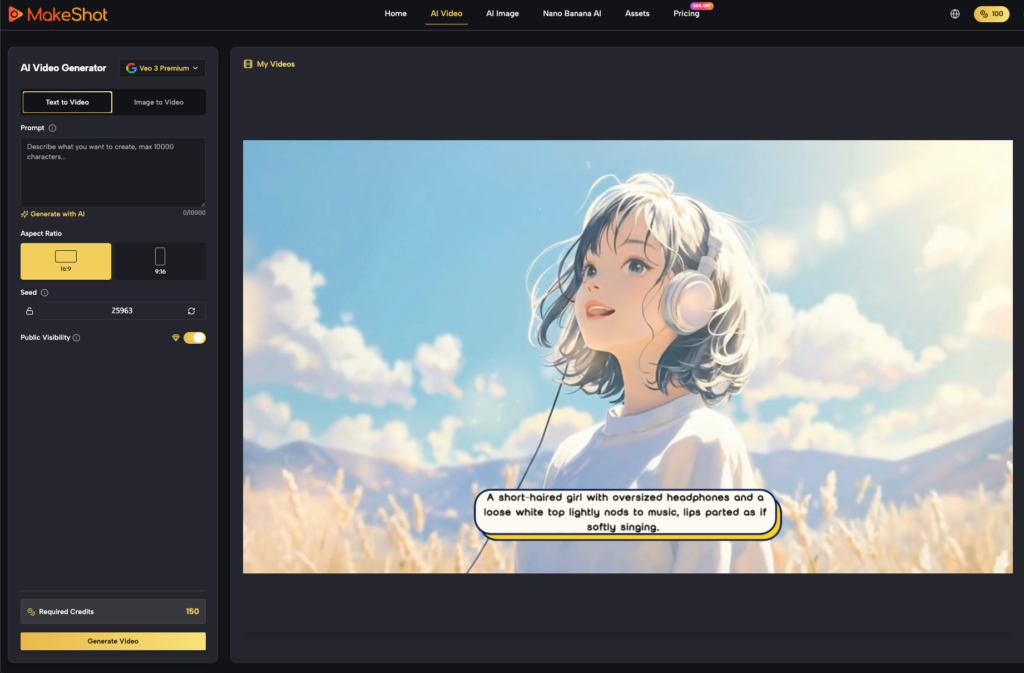
In a pre-AI world, producing these three variations at a high enough fidelity to be believable would require three separate shoots or massive amounts of custom animation. Today, using platforms like MakeShot, teams can leverage models like Sora 2 or Kling to generate these simulations in hours.
The shift here is technical as much as it is strategic. We are moving away from pure text-to-video, which can be too unpredictable for brand work, toward an image-to-video workflow. By starting with a precise product render or a high-fidelity image, the AI is used solely to provide the “kinetic action,” ensuring the product itself remains recognizable and consistent while the environment and emotional tone change.
The Image-to-Motion Pipeline for UI Precision
One of the biggest hurdles in using generative tools for product launches is the risk of “hallucinations.” If you ask a standard AI video generator to “show a user interacting with my app,” it will likely invent buttons, menus, and interfaces that don’t exist, confusing potential customers.
The most effective workflow we’ve seen involves a three-step pipeline:
- Base Frame Creation: Use a tool like Nano Banana on MakeShot to create or refine a high-fidelity base frame. This is where you establish the lighting, the product’s physical appearance, and the layout.
- Kinetic Layering: Use an AI Video Generator to animate specific elements. Instead of animating the whole scene, you focus on the movement—a camera pan, a hand gesture, or a light sweep.
- Model Selection: Different models have different “personalities.” For instance, Google Veo might handle realistic outdoor lighting better, while Kling might excel at complex human-object interactions.
Choosing the right motion control is critical. A “camera follow” movement can make a product feel heroic and expensive, whereas “object movement” (showing the product itself moving) is better for demonstrating utility. Product teams who understand these nuances can “direct” the AI to emphasize the specific value proposition they are testing.
Where the Simulation Breaks: A Reality Check on Physics and Text
It is important to maintain a level of skepticism about what these tools can currently achieve. Despite the rapid progress, we are not yet at the point of “one-click” perfect production.
First, there is the “uncanny valley” of spatial physics. While an AI Video Generator can simulate a sunset or a splashing liquid with incredible realism, it often struggles with precise physical interactions. If your product requires a human hand to interact with a very specific, small mechanical part—like a watch crown or a specialized medical tool—the AI will often “clip” through the object or distort the proportions. In these cases, we advise teams to use AI for the background and atmosphere, but rely on traditional video or 3D renders for the close-up interaction.
Second, text rendering remains a significant limitation. Even with advanced models, “burning in” UI labels or captions directly through a prompt is a recipe for typos and weird glyphs. It is still far more efficient to generate the video “clean” and then add UI overlays or text in a dedicated video editor.
Finally, there is the legal and spec-accuracy constraint. If you are launching a piece of hardware where the exact thickness or port placement is a legal requirement for the ad’s accuracy, you cannot rely on generative video to get those pixels right every time. It is a simulation engine, not a CAD tool.
Establishing Workflow Limits
- Don’t use AI to demonstrate “pixel-perfect” hardware specs.
- Do use it to test whether users respond better to the product being used in a home setting vs. a professional office.
- Don’t expect the AI to understand your brand’s specific hex codes for every frame without significant post-processing.
Operationalizing the 48-Hour Creative Sprint
To truly benefit from this technology, product teams need to move away from “approval by committee.” If you are using AI to generate 10 variations of a hook, you don’t need the VP of Marketing to approve each one. You need a performance lead to ship them, see which one gets the lowest Cost Per Click (CPC), and then double down on that direction.
This allows for a massive reallocation of budget. If you can save 80% on the mock-up and hook-testing phase by using an AI Video Generator, you can take that saved capital and put it directly into your paid testing spend. This creates a feedback loop: the AI generates the hooks, the market identifies the winner, and then you spend the big production budget on a “hero” asset that you already know will perform.
Using a unified platform like MakeShot simplifies this by removing the friction of managing multiple API subscriptions. When a launch team is in a 48-hour sprint, they don’t have time to toggle between different tools to find which model is currently producing the best lighting. Having Veo, Sora, and Kling in one interface allows the operator to focus on the output rather than the infrastructure.
Ultimately, the goal isn’t just to make videos faster. It is to reduce the “cost of being wrong.” By treating your launch creative as a series of low-cost hypotheses, you ensure that when the final product hits the market, the message has already been “market-proven” by the data. The future of product launches isn’t about the one big swing; it’s about the hundred small simulations that lead to a guaranteed hit.