We have officially moved past the “magic trick” phase of generative media. A year ago, the mere ability of a machine to render a photorealistic portrait from a string of text was enough to sustain a marketing campaign. Today, that novelty has evaporated, replaced by a much harsher reality: the generative surplus. While it is now trivial to produce 1,000 images in an afternoon, producing a single image that fits a specific layout, adheres to a brand’s color palette, and lacks distracting visual hallucinations remains a significant challenge.
This gap between raw output and a publishable asset is what I call the “middle mile.” It is the phase of production where a creator’s value shifts from prompt engineering to rigorous editorial judgment. In this environment, the raw generation is rarely the final product; it is merely the high-quality clay. The actual work happens within an AI Photo Editor, where the nuances of composition, lighting, and subject integrity are refined to meet professional standards.
The Generative Surplus and the Problem of Usability
The current state of AI media is defined by an abundance of “almost-right” assets. You might prompt for a “minimalist office setting with soft morning light,” and the model delivers a stunning image—except there is a distorted coffee mug on the desk or the shadows are falling in three different directions. In a traditional workflow, a designer might spend hours trying to re-prompt the model to fix these small details, only to find that changing one word in the prompt alters the entire composition.
This is the hidden cost of the “prompt-only” mindset. When you rely solely on text-to-image generation, you are effectively gambling on the model’s randomness. The professional pivot involves accepting that the initial output will be flawed. The goal is no longer to get a perfect image from a single prompt, but to get an image that is “good enough to edit.” This shift requires a robust AI Photo Editor to handle the granular corrections that text prompts simply cannot manage with surgical precision.
The Middle Mile: Bridging the Gap Between Output and Asset
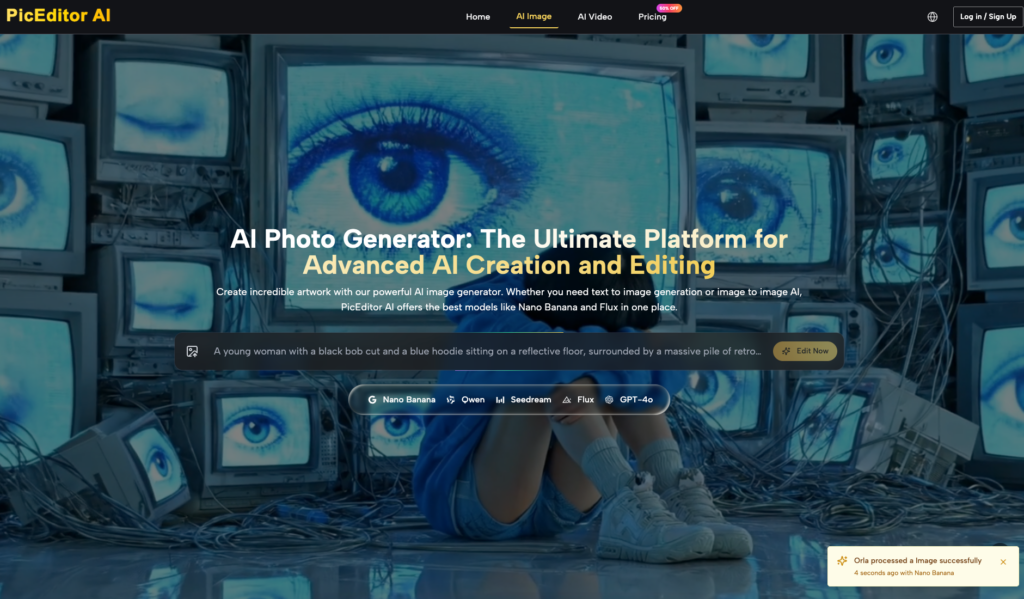
The middle mile is an iterative process. It is where the broad strokes of a generative model like Flux or Nano Banana are narrowed down into a specific visual solution. For creators using platforms like PicEditor AI, this means moving fluidly between different models and specialized editing modules. You might use a high-fidelity model to generate the base scene and then immediately transition into a suite of tools designed for object removal, background adjustment, or face restoration.
This transition from global prompting (the whole image) to local editing (specific pixels) is what separates hobbyist creators from production-ready marketers. In the middle mile, you aren’t asking the AI to “think” for you; you are directing it to perform specific tasks—upscaling a low-res texture, swapping a face for persona consistency, or erasing a stray artifact that breaks the fourth wall of the visual.
Anatomy of a Refined Workflow: Beyond the Initial Prompt
A professional workflow is rarely linear. It usually involves a loop of generation, evaluation, and correction. Here is how that looks when put into practice:
Correcting Generative Drift
Generative models often suffer from “drift,” where the background elements begin to hallucinate or melt into the foreground. An AI Photo Editor allows a creator to use an object eraser or inpainting tool to strip away these distractions without needing to regenerate the entire frame. This preserves the parts of the image that work while surgically removing the parts that don’t.
Face Swapping and Persona Consistency
For brands running multi-channel campaigns, consistency is the primary hurdle. If you generate a hero character for a social ad, you need that same character to appear in a blog header and an email banner. Raw generation often fails here, producing “cousins” of the character rather than the character themselves. By utilizing face-swap technology within an AI Photo Editor, creators can anchor a specific persona across multiple generative backgrounds, ensuring the brand story remains coherent.
Resolution and Texture Recovery
Many generative models produce images that look great on a smartphone screen but fall apart when scaled for a website hero or print. Upscaling is more than just increasing pixel count; it is about recovering the “grit” and texture that models often smooth over in an attempt to look clean. A dedicated editor handles this by intelligently interpolating detail based on the existing composition.
Where the Workflow Breaks Down: The Limits of Correction
It is important to maintain a level of skepticism about what can actually be fixed. Despite the advances in AI-driven tools, there are two specific areas where the middle mile often hits a wall:
- Lighting Mismatch: When you use inpainting to add an object to an existing generative image, the AI often struggles to match the global illumination of the scene perfectly. If the base image has a strong orange sunset light and you inpaint a blue glass bottle, the reflections on that bottle may still feel “detached” from the environment. This is a technical friction point that often requires manual color grading to resolve.
- Structural Integrity: If a generative model fails at basic anatomy—such as a hand with six fingers or a leg that bends at an impossible angle—an AI Photo Editor cannot always “fix” it through simple retouching. In these cases, the structural failure is so deep that attempting to edit it creates a smudged, unnatural look. Here, the expert choice is to abandon the asset rather than over-investing in a broken base.
Practical Judgment: When to Regenerate vs. When to Edit
Efficiency in the AI era is governed by what I call the 70% Rule. If a generated image is 70% of the way toward your vision—meaning the composition, color palette, and main subject are solid—it is almost always faster to use an editor to fix the remaining 30%.
However, identifying “terminal” errors is key. A terminal error is a flaw that would take longer to edit than it would to run five more generations. This includes things like poor perspective or a “style clash” where the AI blended two conflicting aesthetics. Understanding this distinction prevents creators from falling into the trap of over-processing visuals until they hit the “uncanny valley,” where the image looks technically correct but feels inherently “off” to the human eye.
Integrating Iterative AI Into the Creative Stack
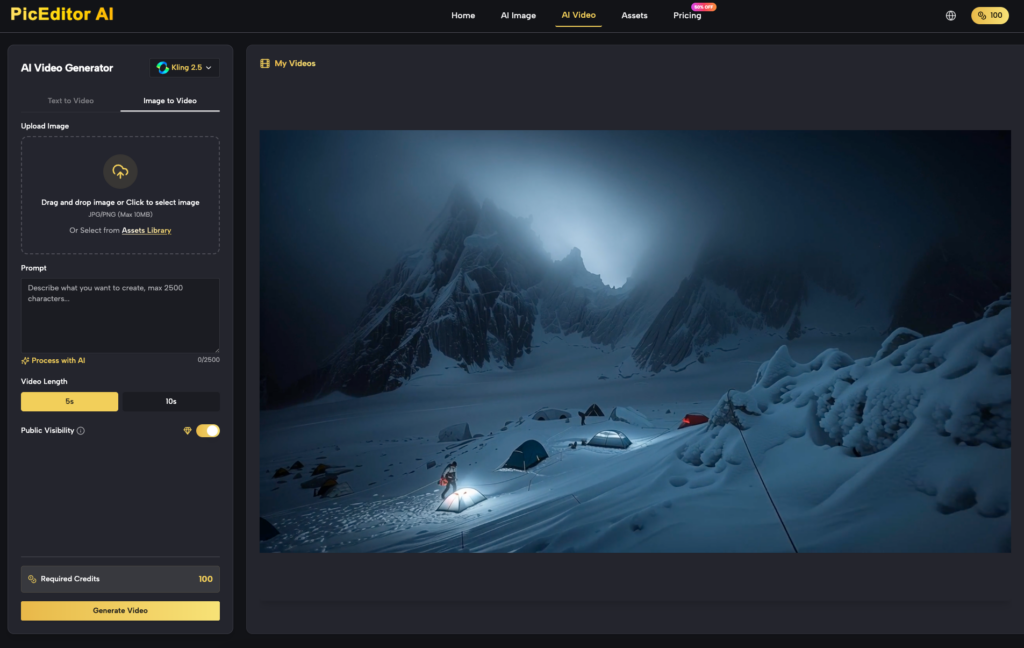
The future of creative production isn’t found in a single “do-everything” button. It’s found in integrated platforms that allow for a non-destructive loop between generation and refinement. Tools like PicEditor AI are moving toward this by hosting a variety of models—from Flux to Kling—alongside a sophisticated Photo Editor. This consolidation reduces the friction of moving assets between different software silos, which is where most creative momentum is lost.
We still cannot safely conclude exactly how “non-destructive” these workflows will remain as file formats evolve, but the current trajectory is clear: the prompt is the starting line, not the finish. The professionals who thrive in the next phase of generative media will be those who view themselves as editors first and prompters second. They understand that the “middle mile” is where the actual value is added, transforming a generic AI output into a deliberate, branded, and professional asset. Professionalism in this new era is defined not by the novelty of what the AI can do, but by the discipline of the human who decides when the work is finally done.